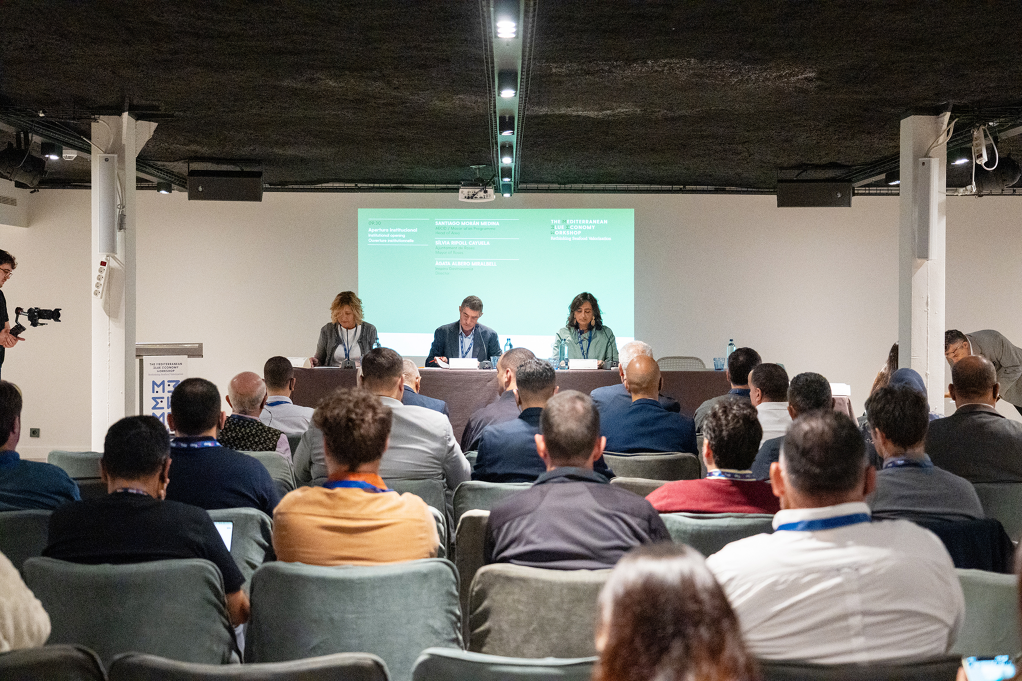
Roses closes a Mediterranean meeting that aims to extract more value from fishing, without fishing more
The Mediterranean Blue Economy Workshop: Rethinking Seafood Valorization meeting closed today at the Castell de la Trinitat in Roses, after three days of work on the comprehensive use of seafood products and the reduction of waste.
-
More than fifty participants from more than ten countries, many of them from the south and east of the Mediterranean, worked for three days on how to take advantage of what is currently discarded or undervalued.
-
The conclusions point out that much of the loss occurs on land, after disembarkation, and that cooking, education and cooperation are keys to creating demand.
-
The participants highlighted as the main result the network created in Roses and a cooperation that goes in both directions, also from the south to the north.
The Mediterranean Blue Economy Workshop: Rethinking Seafood Valorization closed today at the Castell de la Trinitat in Roses, after three days of work on the integral use of seafood products and the reduction of waste. It was organized by the Spanish Agency for International Cooperation for Development (AECID) through Masar al'an, its regional cooperation program with the Arab world, with the technical coordination of Inspira Gastronomia, the technical and logistical support of the Foundation for the Internationalization of Public Administrations (FIAP) and the collaboration of the Roses City Council and the RoseS Fishermen's Brotherhood.
More than fifty people from more than ten countries have participated, including Algeria, Egypt, Jordan, Lebanon, Morocco, Palestine, Syria and Tunisia, along with Cyprus, Spain and Iceland: fishing administrations, research, guilds and cooperatives, companies, cuisine and regional organizations such as the General Fisheries Commission for the Mediterranean (GFCM), the body of the Food and Agriculture Organization of the United Nations (FAO) for fishing in the Mediterranean and the Black Sea, or the Union for the Mediterranean (UfM), which brings together 43 countries in the region. The idea that has guided the work was summarized at the opening by Santiago Morán, head of the Masar al'an area: "It's not about fishing more, it's about getting more value from what is caught: more value per kilo and not more kilos."
A shared starting point
The mayor of Roses, Sílvia Ripoll, opened the meeting by recalling that in Roses "the sea is not just a privileged landscape or a tourist attraction: it is work, it is economy, it is tradition and it is the future". The CGPM explained that overexploited populations have gone from 87% in 2013 to 48% in 2024, but that one in four fish caught still does not reach the market. The Iceland Ocean Cluster, an Icelandic network that brings together companies and research in the marine sector, showed how Iceland uses almost all of its cod, because "waste" is a forbidden word there; the Alícia Foundation, dedicated to research in cooking and food, vindicated everyday cooking, and the UfM placed the meeting on the regional blue economy agenda.
Three experiences from Morocco, Algeria and Jordan showed what already works: women setting up longlines, more selective than nets, in Martil; feed from the by-products of the Algerian fishing industry, and a closure in Aqaba that has returned species to the sea and customers to restaurants. The day was closed by the Director General of Maritime Policy and Sustainable Fisheries of the Generalitat de Catalunya, Itziar Segarra, for whom the best recipe against waste is not to catch what you don't want.
What the groups concluded
Three mixed groups of countries and profiles worked on Monday and Tuesday at the Casal del Pescador on the resource, the value chain and consumption, and visited the fish market, the transformation plant of the local company Pescadors de Roses and a showcooking of the use of the resource at the Fishology restaurant. Regarding the resource, the first condition is selectivity: valorizing without creating incentives to capture juveniles or vulnerable species. The blue crab was the species that is most worrying in the voting of the room, followed by the lionfish and the pufferfish, and several participants asked to prepare to take advantage of the species that arrive before they become a problem. "Biodiversity knows no borders, visas or passports", recalled one of them.
Participants from some Arab countries stated that, in the value chain, the loss occurs mainly on land: there is a lack of ice, cold, labelling, traceability and, in many ports, an organised auction. The proposals include grouping the small volumes of artisanal fishing and recovering traditional techniques such as drying, salting or canning, which do not require large investments. The room chose marketing as the most important link: a good product is of no use if no one buys it.
Regarding consumption, the barriers are mainly cultural, from ignorance to fear of thorns. To overcome them, it was proposed to combine cooking, education from childhood and credible voices, such as those of the fishermen themselves, and bring the lesser-known species of haute cuisine to the everyday table. The role of women and young people was proposed for a future edition.
Cooperate in both directions
In the final debate, "cooperation" was the most repeated word. Several participants stressed that learning does not only go from north to south, because the south and east have been adapting to a changing sea for years. There were also concrete commitments: a Lebanese agri-food cluster will create a group dedicated to seafood, and an Egyptian chef wants to replicate the Roses model, which unites a fish market, a processing plant and gastronomy. "The most valuable thing is the network that has been created," summed up the representative of the General Fisheries Commission for the Mediterranean (CGPM)
What comes next?
The conclusions will be collected in a final document, with possible lines of joint work, which will be received by all participants. The conversation continues under the hashtag #RethinkingSeafood.
About Masar al'an
Masar al'an is the regional cooperation program of the AECID with the Arab world. It promotes social, ecological and economic transition, with priority in Mauritania, Morocco, Algeria, Tunisia, Egypt, Palestine, Jordan and Lebanon, and among its objectives is the promotion of a socially just blue economy. Through Masar Conecta, its line of knowledge and innovation, it brings together administrations, research, business and civil society from both banks around common challenges.